Showing posts with label Science. Show all posts

Friday, February 22, 2013

A trip to the North Pole!

Strange things happen in the North Pole... Almost magic things!
It's very-very cold! ΟK, we all knew that...
But up there in the north everything is different...
Day and night... The sun and the sky...


So, we boarded our Websail and travelled very far away!!
We met the Eskimoes and they told us how they build their igloos, their ice houses.


We arrived there in summertime. During a day that lasts for...6 months!
Even at night, the sun doesn't set... It never hides...


But when it DOES set, it is for good!.
The night there lasts for six months... Yet, it is not always dark...


Original post by Dimitris Alexakis

Tuesday, October 30, 2012

How were the continents formed?

OK, we live in Europe.
But has Europe been in the same position since forever? Has it had the same shape?
Or, maybe, does it travel on the sea?

 Do you ever wonder, how the were continents formed?


Of course, things didn't happen exactly like that... It took a bit more time!
Watch the creation of Planet Earth and its continents...


Are you, by any chance, curious about the future?
Will the continents change places and shapes again?
In the following video you can see not only the past, but also the future of continents...


Original post by Dimitris Alexakis

Friday, June 22, 2012

Signs and messages of communication

The two unrivaled Ms Katerinas strike again!!!
The two fifth grade classes, within the framework of the "Flexible Zone" class, have been exploring and running a flashback to the development of communication from antiquity till today. One of the results of their quest was the song "Signs and Messages of Communication"-given in the modern Greek Sign Language...

"I'm getting a message, talk to you, talk with you...
I'm sending a message, disagree, I love thee...
I'm writing a message asking you to see you...
I'm hearing a message, I agree, I love thee...
I say, listen, I'm walking, you meeting...

Message just for you I am here to tell you...

Even in disagreeing, on this we are agreeing:
We are trying to persuade, rhetoric is being made!"


Wednesday, March 28, 2012

I'm not eating THAT...!

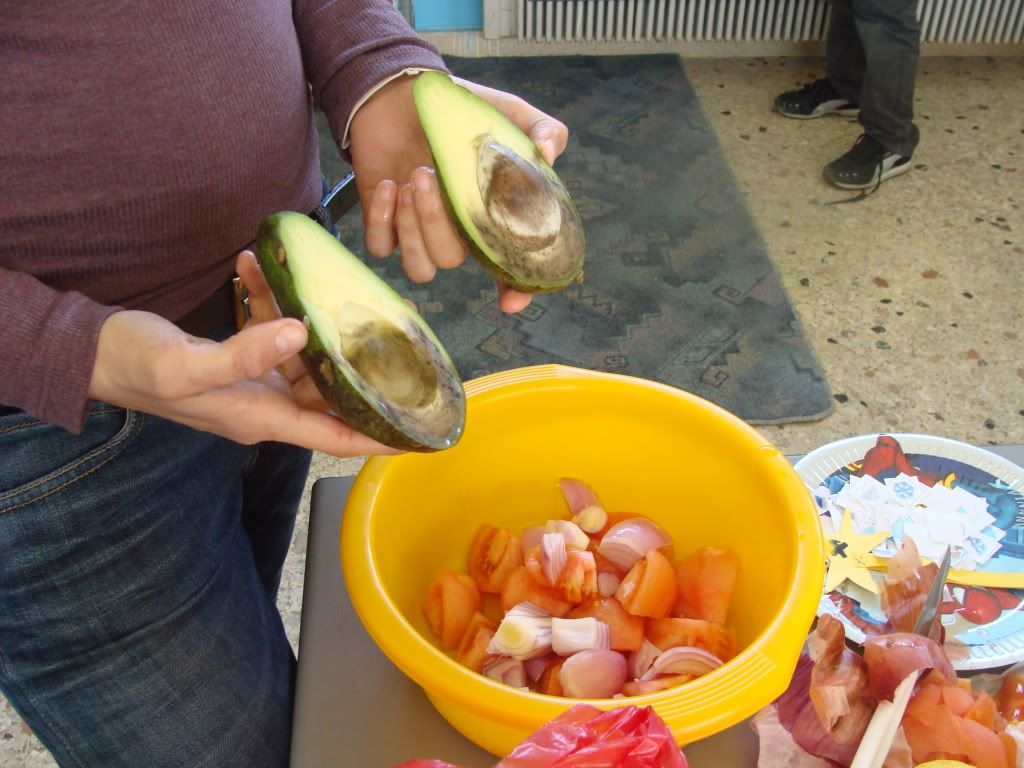
Speaking of fruit, we also talked about the avocado, a fruit a bit unknown to most people, which, however, is cultivated in Crete. We'll find it easily and at a very good price at our neighbourhood greengrocer's or at the street market.
The avocado, as we learnt, is a highly-beneficial food. But it is kind of a...weird fruit! It tastes more like butter, rather than like a fruit.
So, how do we eat it? But, of course, like the Mexicans do! By making "Guacamole"!

Indeed, as it always happens with new things, we were a bit hesitant at the beginning...Most of us stated in disgust: "I'm not eating this thing!!!" Luckily, though, there are always the bold ones who never say no to new tastes...


Half of the ingredients are at place and are waiting for...


...the avocado! It is ripe, as it should be!


   Let's season it with a little salt and pepper!

   Who is the brave one to have the first bite?


   It's delicious, after all! 

 
   Hey...! Don't eat it up! I want some too!!


   Don't forget! Organic waste go to compost!

   Let's write the recipe down to try it at home...


Now the permanent line at the kids' lips is: "Miss, when will we make "guacamole" again?"
So, go ahead! Try it yourselves! You will only need 2 avocados, 2 tomatoes, 1 onion, a little lemon juice, salt and pepper!
You might say the same after you try it!

Some little secrets: 
When you prepare it, put one of the kernels in the bowl with the sauce. It will prevent the "guacamole" from turning black.
And, if you feel like a little gardening and are patient enough, try to put the kernels in water like in the following pictures until they grow roots. Then plant them in a pot!


Original post by Maria Priniotaki


Monday, March 5, 2012

Games that...attract!

In the Science lesson we began studying magnets.
We thought that they were lots of fun so we decided to build a few games!

Magnet fishing!!
The one who catches the most fish faster is the winner.

  
Magnet paintings!!
Become a small Picasso. All you need is tempera colour, a magnet and an iron marble...

Here is one of our masterpieces...


Magnetise and drive!
Drive your car in the city with the help of a magnet!
But, be careful! Always wear your seatbelt and don't speed!


We played, we had fun, but we also invited other classes to come have fun with us! What was your favourite game?


Original post by Dimitris Alexakis


Wednesday, February 22, 2012

Our "salad days"!

Mmm! Our fruits had been waiting patiently for the time when we would peel them and turn them into a wonderful fruit salad! Because, what is better and healthier when you are hungry than a fruit salad at school?
So, in the class of  Environmental Studies, we made two wonderful fruit salads (after washing our fruits)!
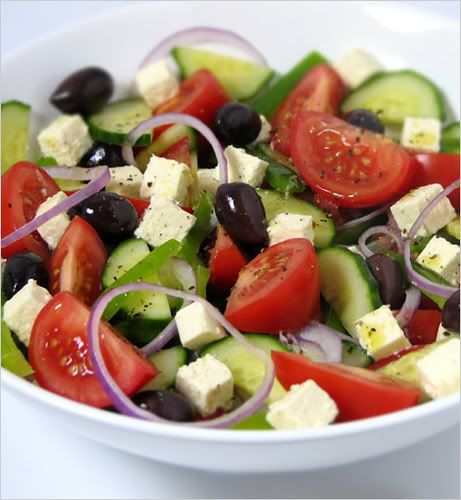
The one looked something like this:
  

Excuse me? That's not a fruit salad? I think you don't know all that WE know!
According to Biology ans scientists concerned with it, tomatoes are also considered to be fruit, as well as cucumbers, olives, avocados and some others most people believe are vegetables!
Why? Because, of course, they contain seeds (kernels) like all fruit!

So as to avoid being called eccentric, we also made a "regular" fruit salad, with apples, bananas, oranges and tangerines!
Unfortunately, we have no photos to show you because we...bolted it down instantly! Because we (C'2 kids) are a bit lickerish, you know!
As for the fruit skins? We collected them and threw them into the compost grid of our school garden to help make our own natural fertiliser!


Original post by Maria Priniotaki


Wednesday, February 1, 2012

Archimedes, our great mathematician and inventor.

      Archimedes is one of the greatest mathematicians and inventors of antiquity. He lived in Syracuse, a Greek settlement in Sicily in the 3rd century B.C. (287 B.C. - 212 B.C.). He was the king's relative and he could have a good position by him, but he preferred to study. So he travelled to Alexandria of Egypt and  studied with Eratosthenes, the great mathematician.
      Archimedes became famous in Syracuse, because he solved the problem of the King's crown. The King had asked for a new golden crown. However, he couldn't be sure if the crown was really made out of pure gold:


When the Romans attacked Syracuse in order to conquer it years later, Archimedes helped a lot in the town's defence with his famous war machines.


      He made big "mirrors" which reflected the sun's light and burnt the enemy ships.
      He also built huge hooks, which caught the enemy ship, lifted it up in the air and crashed it onto the rocks.


Original post by Dimitris Alexakis


Friday, December 9, 2011

Kepler 22-B: Earth's bigger brother

What belonged to the sphere of science fiction until recently is now a scientific reality. NASA confirmed that Kepler 22-B, an "exoplanet" which is located 600 years of light away from the Earth, might be hosting life.


This is how NASA's artist imagined Kepler 22-B. In fact, noone knows wether the planet has clouds or sea, if it is a rocky or gas planet. It is 2 and a half times bigger than the Earth, located in the "temperate zone" of the solar system, that is in a point where the existence of water in a liquid state is allowed on its surface. It revolves around its star in a distance 15% shorter than that which separates the Earth from the Sun. However, because its sun transmits 25% less light than ours, the conditions are much alike the ones on the Earth. The average temperature on Kepler 22-B is estimated at around 22°C.


Kepler 22-Β is the first planet for which there is confirmation that it could be hosting forms of life. But it's not the only one. NASA is examining data on another 47 possibly inhabitable planets.

Original post by Dimitris Alexakis

Saturday, December 3, 2011

Experimenting with heat...

In our last Science class we researched the transfer of heat through waves.
Through an experimental activity, we understood how hot water goes upwards, hile cold water goes downwards.

Mr Steve Spangler performs a similar activity in the following video.
In a rather...impressive way...!

Watch the video here:

and... try it out at home.
The only things needed are a little coloured water, two same bottles and a playing card.

You can find more fascinating experiments on Mr Spangler's channel on youtube:
http://www.youtube.com/user/SteveSpanglerScience


Original post by Dimitris Alexakis

Friday, November 25, 2011

Volcanoes...strictly for school use!

They are kids and they come up with ideas! All the time! The idea that had settled itself in their minds at that period was to make volcanoes!
They weren't interested in seeing images and videos, the point was that they saw the red lava flowing in front of their eyes!
The day when a student brought from home his mum's...cooking tray to build in it his own volcano, I realised that it couldn't wait any longer...
Venture "Volcano" so begins...

What we needed:
A bottle of orange juice (which was our "volcano") and clay to build its slopes as life-like as possible!

...science time had come...
We put some cooking soda, some water and a little washing-up liquid in a small funnel and into the volcano...but nothing happened!
Something is needed to make the soda foam to create our lava!
What would that be?
Vinegar (with a few drops of red ink to make our lava red)!

...and the result was something like this:
 
This was one of the two volcanoes that was made by the 5th
grade students (school year
 2009-2010)

Original post by Maria Priniotaki